Cart
0
Add $150.00 more for free shipping!


High end dinnerware comes down to weight, glaze finish, edge quality, color depth, coordinated flatware, matching linens, and whether the pieces are sold as a complete system rather than single items. Mass produced sets usually fail at least two of these seven tests, which is why two plates that look alike in a photo can feel completely different on a table.
We built this list by pulling apart an actual working luxury tableware line rather than repeating generic buying advice, so every point below has a real product behind it.
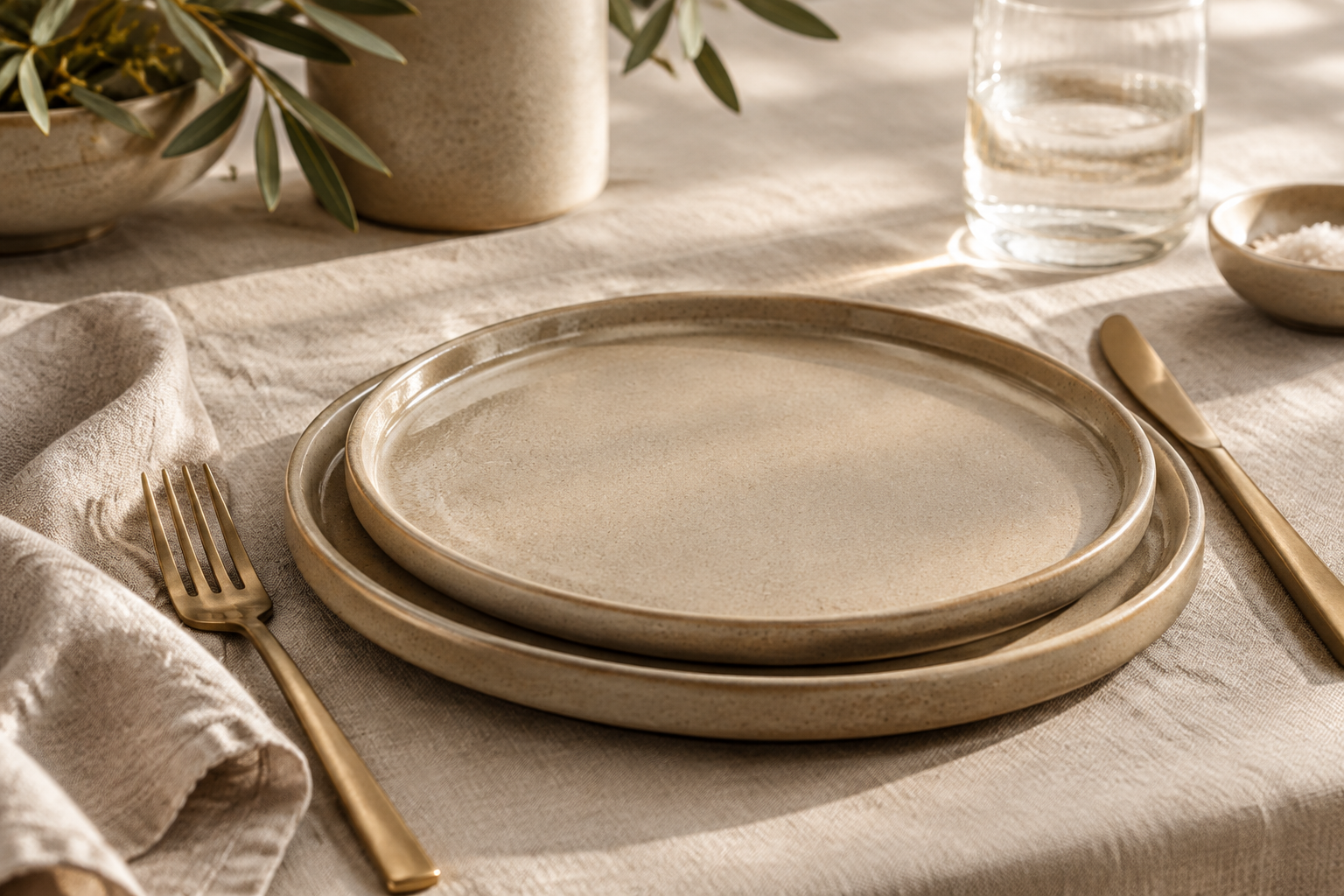
Before you even look at a plate, you feel it. Heavier stoneware almost always means a denser clay body and a thicker glaze layer, and that density is expensive to produce at scale, which is exactly why mass market dinnerware skips it. A set like the Stoneware Dinner Plates, sold in groupings of four alongside matching salad and saucer plates, is built heavier on purpose. Pick up a plate in a store before buying it online. If it feels light and hollow, the rest of the details on this list will not save it.

This is counterintuitive to a lot of shoppers, who assume shine equals quality. In practice, the opposite is usually true. A high gloss finish is the fastest and cheapest way to hide an uneven clay surface, which is why it shows up constantly on budget dinnerware. A matte stoneware glaze cannot hide anything, so a brand only uses it when the surface underneath is already good. The entire stoneware collection leans into this matte finish rather than a glossy one, and it is one of the fastest tells when you are comparing two sets side by side online.
Run a finger along the rim of a plate. A mold seam, a slightly sharp lip, or a perfectly identical edge on every single piece is a sign of high volume injection casting. A hand finished edge will have tiny, natural irregularities from piece to piece, because no two were pressed in the exact same mold pass. This is one detail that photographs almost never capture, which is exactly why reviews and in person handling matter more for dinnerware than for most other home categories.
Flat, perfectly even color across every plate in a set is a manufacturing shortcut, not a sign of quality. Real stoneware glazes pick up subtle variation from the kiln, the batch, and the glaze thickness, which gives the color actual depth instead of a flat printed look. If every saucer plate in a set of four looks exactly identical under close inspection, that uniformity is a red flag rather than a feature.

Cutlery Set - 20 piece Shinny Black Flatware Sets
This is a detail most buying guides skip entirely, and it is one of the most reliable tells there is. Cheap dinnerware is almost always sold with no thought given to what flatware sits next to it. A properly built tableware line designs the flatware as part of the same system from the start, which is why a 20 piece set shows up in black, gold, or nickel finish, each one built to sit next to the same stoneware without clashing. If a brand sells dinnerware and flatware as two completely unrelated product lines with no shared design language, that is a sign the table was never considered as a whole.
The gap between a table that looks staged and one that looks genuinely put together is almost always the linens. A set of four linen napkins in a tone that was clearly chosen to sit next to the stoneware, rather than grabbed separately from a different store, is what makes the whole table read as intentional. This is a small line item in most budgets, but it does more visual work than almost anything else on the table.
The clearest signal of all is structural. A genuinely high end dinnerware brand sells a dinner plate, a salad plate, a saucer, a cup, a pitcher, flatware, and linens as parts of one coherent dinnerware system, each sold in sets of four so a full table setting is a deliberate purchase rather than a scramble to find matching pieces later. A single plate sold on its own with no matching companions is almost always a sign the brand is selling an item, not a table.
| Signal | High end dinnerware | Mass produced dinnerware |
|---|---|---|
| Weight | Noticeably heavy, dense clay body | Light, hollow feeling |
| Finish | Matte stoneware glaze | Glossy, mirror like coating |
| Edge | Slight natural variation | Perfectly uniform mold seam |
| Color | Subtle depth and variation | Flat, printed looking tone |
| Flatware | Designed to match, sold as a set | Sold completely separately |
| Linens | Coordinated tone and texture | Not considered at all |
| Structure | Full system sold together | Single plates sold alone |
Most dinnerware buying advice stops at color and pattern, which is exactly why so many people end up with a table that looks fine in photos but feels thin in person. The seven details above, weight, finish, edge, color depth, flatware pairing, linen pairing, and whole system design, are the ones that actually separate a table that reads as considered from one that reads as purchased in a hurry. If you are building a table from scratch, start with the dinnerware sets collection and build outward to flatware and linens rather than buying each piece from a different place.