Cart
0
Add $150.00 more for free shipping!


You're standing in a store, or scrolling a product page at midnight, and the listing says "genuine leather." Cool, but is it actually? Here's the uncomfortable truth: "leather" gets used pretty loosely in fashion, and a lot of bags marketed as leather are really some version of plastic doing a decent impression of it. The good news is you don't need to be an expert to spot the difference. You just need to know what to check.
This one sounds silly, but it's genuinely one of the most reliable tests. Real leather has a distinct, earthy, slightly sweet smell, it's the smell of an actual animal hide that's been tanned, and it's honestly hard to fake. Synthetic leather, on the other hand, usually smells like plastic or has a faint chemical edge, sometimes masked with a manufactured "leather scent" that smells a little too perfect and a little too consistent.
If you can get close enough to smell a bag before buying, do it. It's a fast, no-tools-needed way to get a real answer.
Real leather comes from an actual animal hide, which means the surface is never perfectly uniform. You'll see small variations, tiny pores, subtle texture shifts, maybe a faint natural mark here and there. It's imperfect in a way that's hard to manufacture.
Faux leather, by comparison, tends to have a grain pattern that repeats. If you look closely and notice the exact same texture pattern showing up over and over across the surface, almost like wallpaper, that's a strong sign you're looking at a printed or embossed synthetic rather than the real thing.
Real leather has a certain give to it. Press on it gently and it should respond a little, maybe even show a faint crease, and then slowly settle back. It feels slightly cool at first touch and warms up as you hold it, the same way natural materials tend to.
Synthetic leather usually feels more uniform and a little too smooth, almost plasticky, and it doesn't really respond the same way when you press on it. It also tends to stay the same temperature no matter how long you're holding it, since there's no natural material breathing underneath.
This is one people skip, but it tells you a lot. On a real leather bag, if you look closely at a cut edge, like the edge of a strap or a seam, you'll usually see a fibrous, slightly rough texture, almost like the cross-section of a natural material, because that's exactly what it is.
On faux leather, cut edges often look flat, smooth, and a little too clean, sometimes with a visible fabric backing peeking through, since most synthetic leather is actually a layer of plastic coating bonded to a fabric base underneath.
If you're allowed to test the actual bag (and obviously, ask first if it's not yours), a small drop of water can tell you a lot. Real leather is porous, so a drop of water will slowly absorb into the surface and darken that spot slightly. Synthetic leather is basically waterproof by nature, so water will just sit on top or bead up and roll right off.
This isn't a test you want to do on a bag you're not sure about returning, but it's a genuinely reliable way to check if you already own the piece and are trying to figure out what you're working with.
Beyond just knowing what you're paying for, real leather and synthetic leather age completely differently. Good leather develops a patina over years, softening and deepening in color the more you use it. Synthetic leather doesn't do that, it typically just wears out, cracking or peeling as the plastic coating breaks down over time, and once that starts, there's no bringing it back.
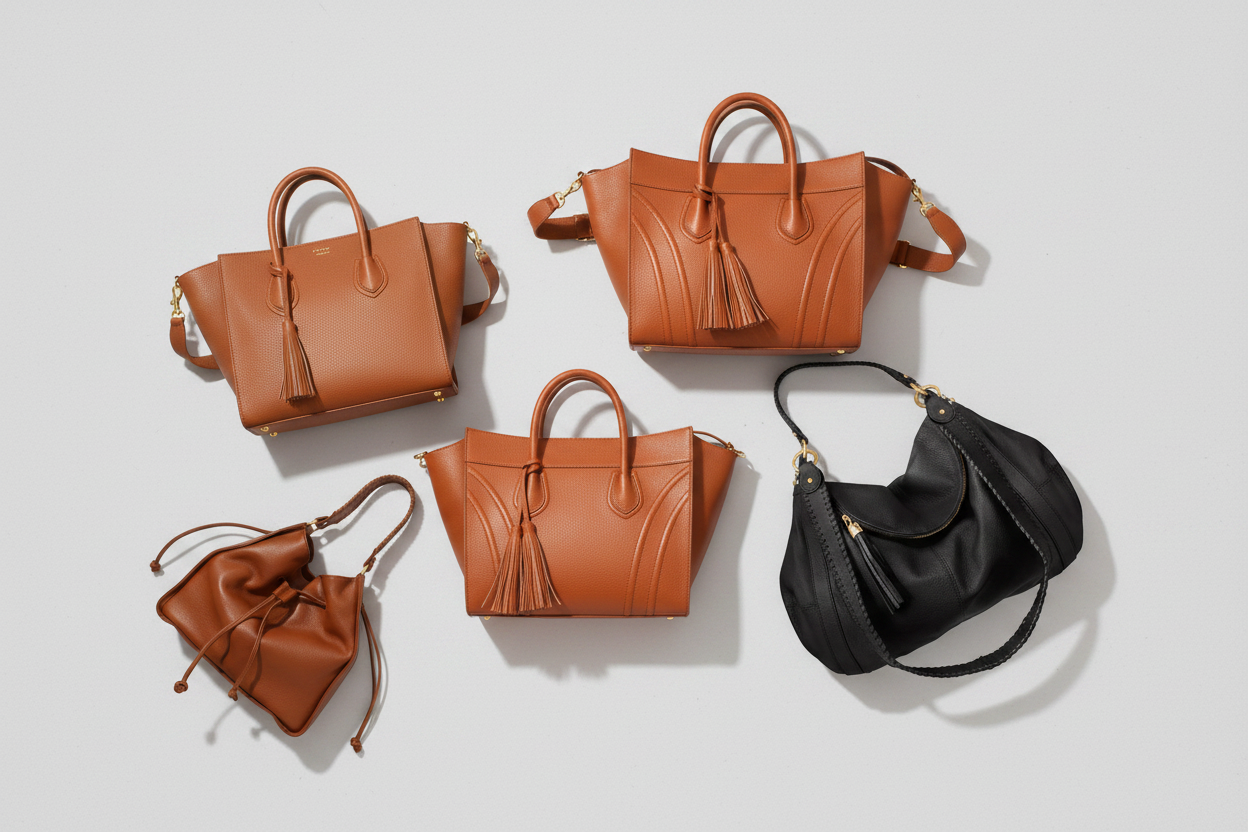
At Onna Ehrlich, our bags are carefully handmade from premium leather and suede, which is exactly why they're built to hold up for years rather than a season or two. That's been true since Onna started designing accessories nearly twenty years ago, blending California sophistication with her Nigerian heritage into pieces meant for real, everyday use, not just how they photograph on day one. It's part of why the collection has found its way into InStyle, WWD, and O Magazine, and onto shoulders far beyond our own customers. But honestly, you don't need to take our word for any of it. Once you know what to look and feel for, you can check it yourself, on our bags or anyone else's.