Cart
0
Add $150.00 more for free shipping!


You've got the menu planned, the wine picked out, maybe even candles ready to go, and then you look at the table and just kind of freeze. Which fork goes where again? Does the napkin go on the plate or next to it? Honestly, most of us learned this by half-watching someone else do it once, which means we're all winging it a little.
Good news: setting a table isn't actually complicated once you know the logic behind it. It's not a memorization test, it's just a system, and once it clicks, you'll never have to second-guess it again.
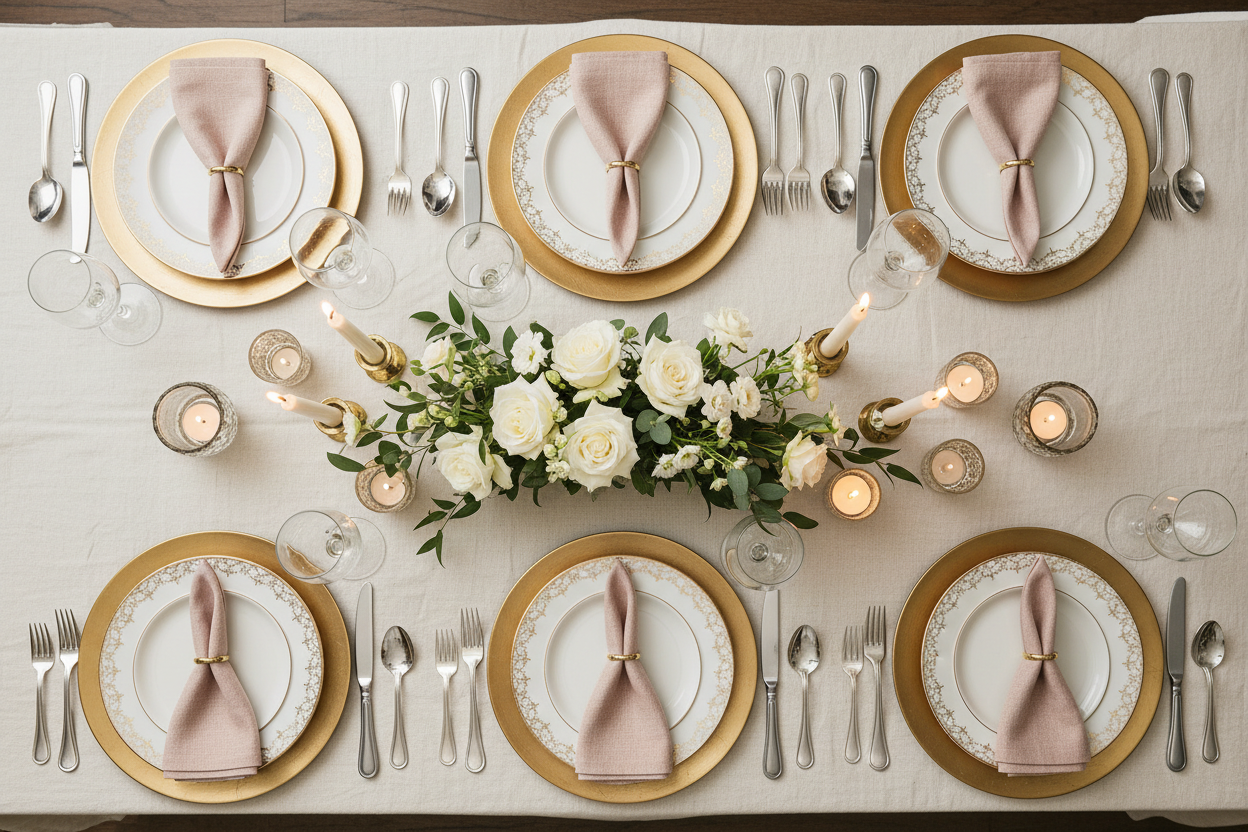
Here's the part that trips people up the most, but it's simpler than it looks. Utensils are placed in the order they'll be used, working from the outside in. So whatever course comes first goes on the outside, and you work your way toward the plate as the meal progresses.
Start with the plate in the center. That's your anchor point, everything else gets built around it.
Forks go on the left, in the order they'll be used, appetizer or salad fork on the outside, dinner fork closer to the plate.
Knives and spoons go on the right, knife blade facing in toward the plate, and spoons to the right of the knife. If soup's on the menu, the soup spoon sits furthest right, since it's usually the first course.
Glasses go above the knife, arranged loosely in the order you'll use them, water glass closest to you, then wine glasses angled slightly to the right if you're pouring more than one.
The napkin goes either on the plate itself or just to the left of the forks, folded simply. Don't overthink this one, a clean fold looks more intentional than something elaborate anyway.
Bread plate, if you're using one, sits above the forks on the left side, with a small butter knife resting across it.
That's genuinely the whole structure. Once the plate's centered, everything else just falls into place around it based on when it gets used.
You don't need twelve pieces of flatware and three types of glassware to pull this off well. For a solid, everyday-elegant dinner party setup, you're really just working with:
Add pieces as your menu actually calls for them. If there's no soup, skip the soup spoon. If it's a one-glass kind of night, skip the extra stemware. The table should reflect the meal, not the other way around.
Once the basics are down, these details are what actually make a table feel considered rather than just functional:
Line everything up. Flatware roughly an inch from the table's edge, evenly spaced, looking intentional rather than scattered.
Center the plate, don't just eyeball it from one angle, walk around and check from a couple of sides.
Add one layer of texture. A runner under the plates, a few low candles, or a small centerpiece goes a long way without requiring an actual event budget.
Keep centerpieces low. Nobody wants to have a conversation around a floral arrangement. Anything on the table should let people actually see each other.
A lot of people assume "properly set" automatically means formal, full stemware, chargers, place cards, the whole production. It doesn't. A casual dinner with friends just uses a scaled-down version of the same logic, fewer pieces, simpler napkin fold, one glass instead of three. The underlying system stays exactly the same either way. Formality is really just a matter of how many pieces you're including, not a different set of rules entirely.
Once you understand that everything's arranged by order of use, working outside in, the whole thing stops feeling like guesswork. Plate in the center, forks left, knives and spoons right, glasses up top, napkin wherever feels natural. That's genuinely the whole system, dressed up or scaled down depending on the night.
Table setting isn't just theory for us. Onna Ehrlich started nearly twenty years ago designing handbags that blended California sophistication with Onna's Nigerian heritage, and that same instinct for quality over quantity eventually grew into a full home collection, stoneware, flatware, and table linens designed to work together the way a considered table should. We build our stoneware to be genuinely used, not just displayed, dishwasher and microwave-safe, so it holds up to real dinner parties and ordinary Tuesdays alike. If you're putting a table together and want pieces that already work as a set, that's exactly what our dinnerware, flatware, and linen collections are built for.